




What's in Signal, and what the research says about each ingredient
Signal is two capsules, taken at eleven, for the part of the afternoon that goes quiet. There are five botanical actives and six nutrients in it. Below is each one, the amount in a serving, and the research we looked at when we chose it. Some of that research is strong, some is early, and we say which is which.
One thing first. In the UK and EU, the only claims a supplement can make about the mind are the authorised ones, and for Signal those come from zinc and the B vitamins. Everything else here is the research behind the ingredients, offered so you can read it rather than take our word.

Zynamite® mango leaf extract, 300mg
A standardised extract of the leaf of Mangifera indica, providing at least 45mg of mangiferin, the polyphenol the research is built on. This is the ingredient that gives Signal its lift, and the reason it works without caffeine (there is under a milligram in a serving, from the green tea extract).
The study to read is from Northumbria University's Brain, Performance and Nutrition Research Centre, published in Nutrients in 2020. Healthy adults took a single 300mg dose, the same as one serving of Signal, and were tested over six hours. They performed better on attention and reaction-time tasks and reported feeling less tired than on placebo. A second trial from the same group in 2024 looked at 300mg and 500mg again and found similar effects on accuracy. Two trials from one lab is a decent start rather than a settled matter.
Cognizin® citicoline, 250mg
Citicoline is a compound your body makes on its own and uses to build phospholipids in nerve cell membranes. Cognizin is the branded form used in most of the published trials.
The trial most relevant to Signal is a 2012 study in Food and Nutrition Sciences in which healthy adult women aged 40 to 60 took 250mg or 500mg a day for 28 days and improved on a test of attention and impulse control at both doses. A later trial in the Journal of Nutrition in 2021 found 500mg a day for twelve weeks improved memory scores in healthy adults over 50. Worth knowing: in 2024 EFSA reviewed a proposed claim that citicoline "supports memory function" and decided the evidence was not yet strong enough to authorise it. That is why it is on this page and not on the tin.

Lion's Mane, 125mg of a 12:1 extract
Hericium erinaceus, the mushroom. Our 125mg is a 12:1 fruiting-body extract, so it stands in for around 1.5g of mushroom. Most of the older research is on people with mild cognitive impairment, at higher doses. The trial that applies to healthy adults is a 2023 pilot from Northumbria University in which young adults took 1.8g a day for 28 days and showed faster performance on a cognitive task after a single dose and lower self-reported stress after four weeks. It is a small pilot, labelled as one by its authors, and we treat it that way.
Korean ginseng, 100mg of a 10:1 extract
Standardised to at least 20mg of ginsenosides. Ginseng has the longest research history of anything in Signal. A series of trials at Northumbria in 2005 and 2006 found single doses of a standardised extract improved performance and reduced mental fatigue during an hour of demanding mental work, and a 2010 follow-up found improvements in working memory and calmness ratings.
L-theanine, 100mg
An amino acid from green tea, and the calm half of the formula. In a 2019 randomised trial in Nutrients, healthy adults who took 200mg a day for four weeks reported lower stress and better sleep and improved on verbal fluency and executive-function tasks. Signal has 100mg, at the lower end of what has been studied, because we wanted the steadying effect without the drowsiness some people report at higher amounts.
Zinc and B vitamins
Each serving gives 30 per cent of the reference intake of zinc, niacin, vitamin B6, folate and pantothenic acid, and 500 per cent of B12 (as methylcobalamin). These are the authorised claims, worded as the regulation words them:
- Zinc contributes to normal cognitive function.
- Niacin, vitamin B6, folate, vitamin B12 and pantothenic acid contribute to the reduction of tiredness and fatigue.
- Pantothenic acid contributes to normal mental performance.
How to take it
Two capsules with water, late morning. The point of eleven o'clock is to be ahead of the afternoon dip rather than chasing it. A tin of Signal is 56 capsules, which is 28 days. If you already take HIRO hydration in the morning, the Hydration + Signal bundle puts both in one box a month. Signal contains green tea extract, so it is unsuitable during pregnancy or breastfeeding and for anyone under 18, and should be taken with food rather than on an empty stomach.
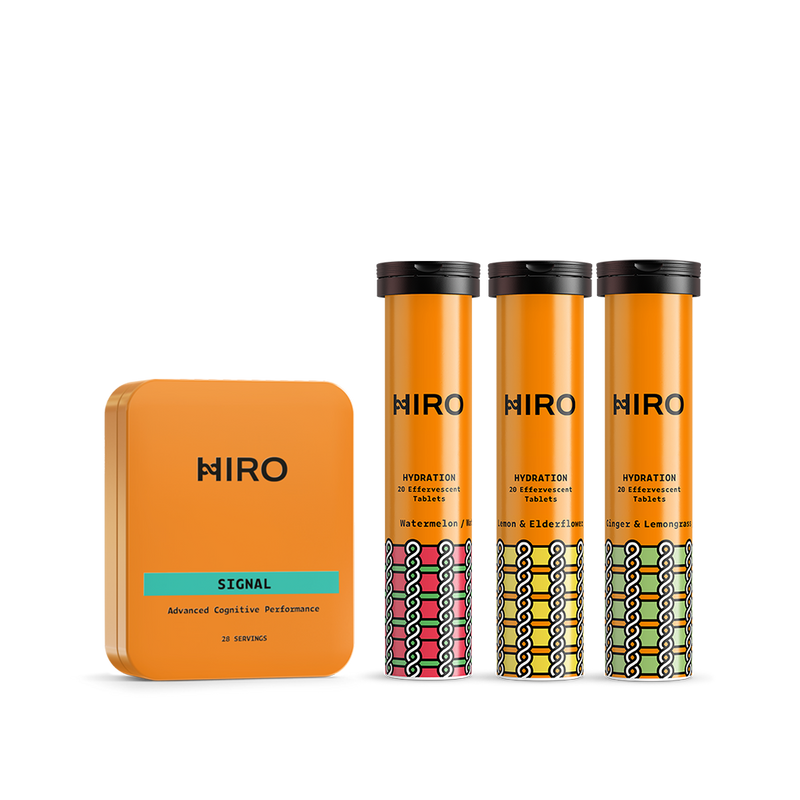
Hydration + Signal bundle
Morning and afternoon, one box a month.
£54 · £45.90 on subscription
Get the bundle →Read the research
- Wightman EL et al. Acute Effects of a Polyphenol-Rich Leaf Extract of Mangifera indica L. (Zynamite) on Cognitive Function in Healthy Adults. Nutrients, 2020. pmc.ncbi.nlm.nih.gov/articles/PMC7468873
- Acute effects of mango leaf extract on cognitive function in healthy adults: a randomised, double-blind, placebo-controlled crossover study. Frontiers in Nutrition, 2024. www.frontiersin.org/journals/nutrition/articles/10.3389/fnut.2024.1298807/full
- McGlade E et al. Improved Attentional Performance Following Citicoline Administration in Healthy Adult Women. Food and Nutrition Sciences, 2012. www.scirp.org/html/8-2700397_19921.htm
- Nakazaki E et al. Citicoline and Memory Function in Healthy Older Adults. Journal of Nutrition, 2021. pmc.ncbi.nlm.nih.gov/articles/PMC8349115/
- EFSA Panel on Nutrition. 'Citicoline' and support of the memory function: evaluation of a health claim. EFSA Journal, 2024. efsa.onlinelibrary.wiley.com/doi/10.2903/j.efsa.2024.8861
- Docherty S et al. The Acute and Chronic Effects of Lion's Mane Mushroom Supplementation on Cognitive Function, Stress and Mood in Young Adults. Nutrients, 2023. pmc.ncbi.nlm.nih.gov/articles/PMC10675414/
- Reay JL, Kennedy DO, Scholey AB. Single doses of Panax ginseng (G115) reduce blood glucose levels and improve cognitive performance during sustained mental activity. Journal of Psychopharmacology, 2005. journals.sagepub.com/doi/10.1177/0269881105053286
- Reay JL et al. Panax ginseng (G115) improves aspects of working memory performance and subjective ratings of calmness in healthy young adults. Human Psychopharmacology, 2010. onlinelibrary.wiley.com/doi/10.1002/hup.1138
- Hidese S et al. Effects of L-Theanine Administration on Stress-Related Symptoms and Cognitive Functions in Healthy Adults. Nutrients, 2019. www.mdpi.com/2072-6643/11/10/2362
- Commission Regulation (EU) No 432/2012, list of permitted health claims (zinc, B vitamins). eur-lex.europa.eu/eli/reg/2012/432/oj